
New study summary · Clear aligner biomechanics
Expanding the upper arch with aligners tips premolars buccally. A new CBCT + FEA study quantifies how buccal bone thickness and buccal root torque interact, and finds a clear sweet spot.
KEY TAKEAWAYS
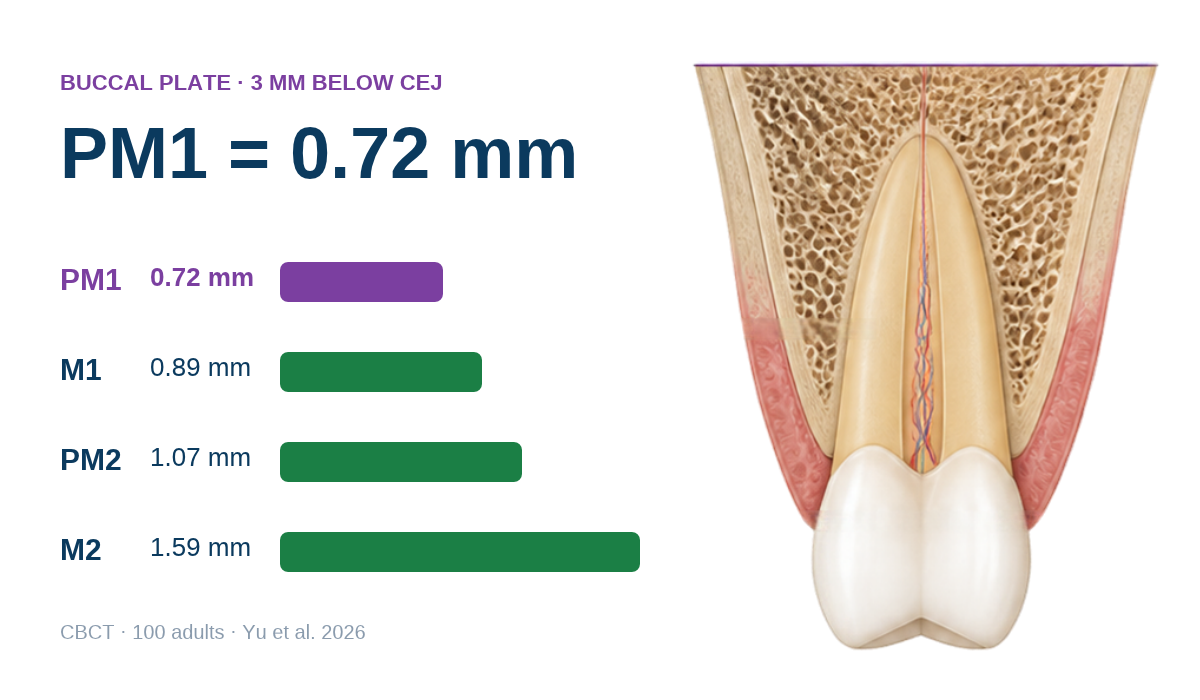
- The maxillary first premolar has the thinnest buccal plate of the posterior teeth: 0.72 ± 0.30 mm at 3 mm below the CEJ.
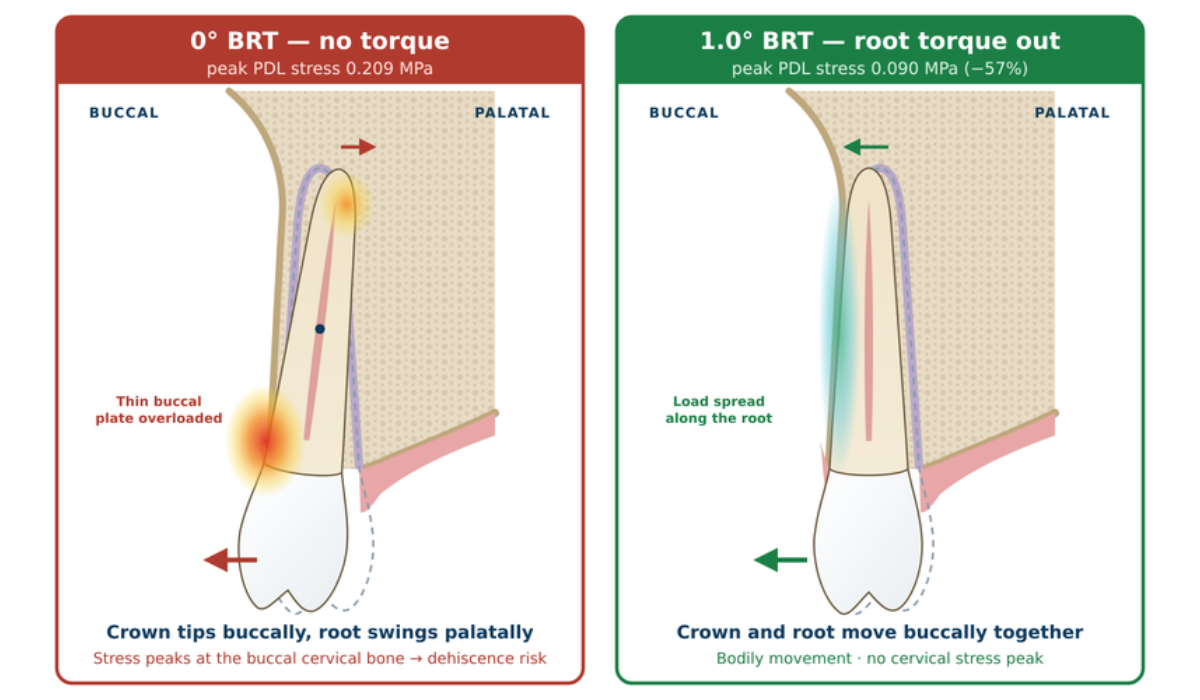
- Expanding without torque in thin bone produces pure crown tipping and peak stress at the cervical PDL.
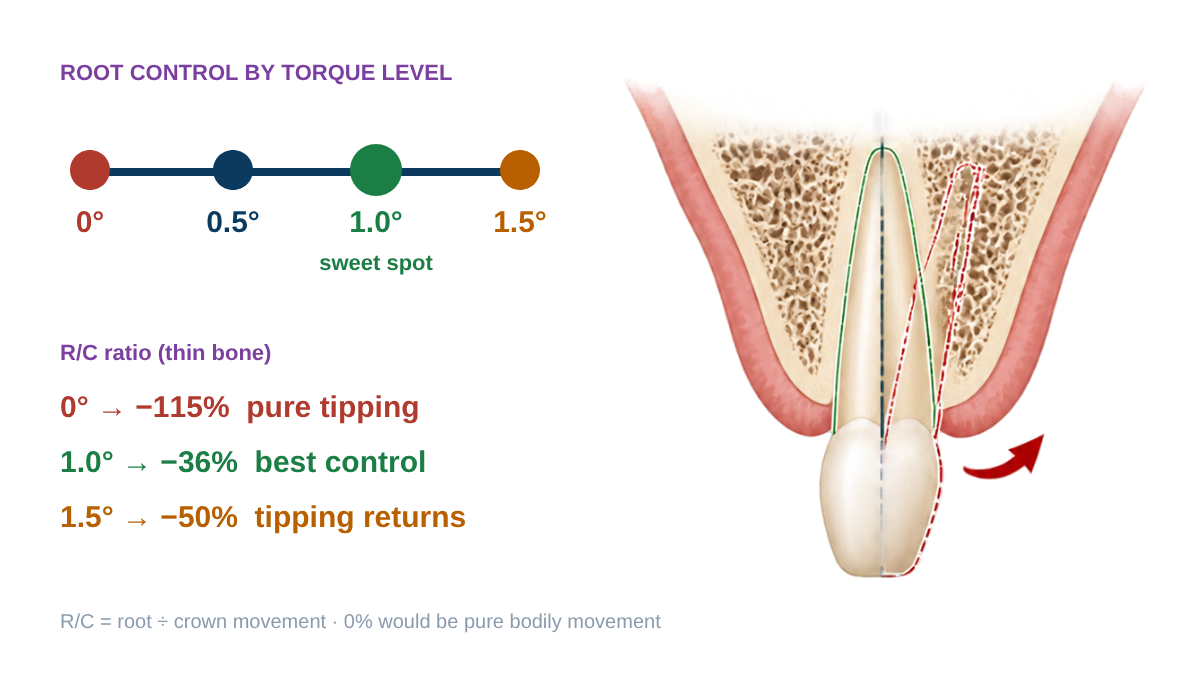
- 1.0° of buccal root torque cut PDL stress by 57.1% in thin bone and gave the best root control in all three bone models.
- 1.5° did not add benefit: stress and tipping rose again.
Why this question matters
Aligners deliver force on the crown, and root control during transverse expansion is limited. The result is buccal tipping of posterior teeth instead of bodily movement, which concentrates stress in the cervical cortical bone and the PDL. In patients with a thin buccal plate, that is a direct path to dehiscence and fenestration. Buccal root torque (BRT) is the obvious tool to counter it, but how much, and does it depend on the bone?
What the authors did
Yu et al. (Am J Transl Res, 2026) combined two parts. First, a CBCT analysis of 100 adults (20–30 years, 800 teeth) measuring the buccal plate of PM1, PM2, M1 and M2 at 3, 6 and 8 mm from the CEJ and at the apex. Second, a 3D finite element analysis: three maxillary models with a thin (0.42 mm), medium (0.72 mm) or thick (1.02 mm) plate at PM1, each combined with four BRT prescriptions (0°, 0.5°, 1.0°, 1.5°) and a 0.2 mm buccal expansion step, 12 models in total.
Finding 1: PM1 is the weak point
At 3 mm below the CEJ, PM1 measured 0.72 mm, significantly thinner than every other site (PM2 1.07 mm, M1 mesiobuccal 0.89 mm, M2 mesiobuccal 1.59 mm). Bone thickens toward the apex at every tooth, so the cervical 3 mm is the real danger zone during expansion.
Finding 2: torque cuts the stress
In the thin-bone model without torque, PDL stress concentrated at the neck of PM1. Adding 1.0° of BRT reduced peak stress by 57.1% and moved the tooth more bodily. The lowest stress in each bone model came from 1.0°.
0° BRT · THIN BONE
0.209 MPa
crown tips, stress at the neck
1.0° BRT · THIN BONE
0.090 MPa
−57% · more bodily movement
Finding 3: more torque is not better
Root control was measured as the R/C ratio (root movement ÷ crown movement). In thin bone at 0°, the ratio reached about −115%: the root swung further than the crown in the opposite direction, which is pure tipping. At 1.0° it improved to about −36% in all three models, so pure bodily expansion is still not fully achieved, but tipping is much better controlled. At 1.5°, stress increased again and crown tipping returned (around −50%). Overshooting torque costs control.
How I apply it in treatment planning
- Measure first. Check the PM1 buccal plate 3 mm below the CEJ on CBCT before planning expansion.
- Never expand premolars at 0° BRT, especially when the plate is thin.
- Start around 1.0° BRT. The authors suggest ≈1.0°–1.5° individualised to bone thickness; their data favour 1.0°.
- Don't stack torque beyond that expecting extra safety.
Limitations
The FEA model came from a single volunteer, used linear isotropic materials (the real PDL is non-linear and viscoelastic), included no attachments, simulated one 0.2 mm step and shows immediate stress only, with no remodelling. Treat these numbers as biomechanical guidance, not clinical proof, until clinical and CBCT follow-up studies confirm them.
Want to plan expansion with confidence?
PredictSmile offers treatment planning services and OnyxCeph training focused on aligner biomechanics.
Visit predictsmile.comReference: Yu T, Yang Y, Liu Y, et al. Three-dimensional finite element analysis of bracketless clear aligner expansion with different buccal bone plate thicknesses. Am J Transl Res. 2026;18(5):3783–3793. doi:10.62347/EYJB3618
Latest Articles
All Articles
Essential Tips for Precision in Dental Segmentation
In digital orthodontics, small errors create big problems. Misplaced mesial or distal points during segmentation can compromise spacing, movement, and aesthetics. This post shows how to avoid the pitfall, improve IPR, and achieve predictable, balanced results across OnyxCeph, Nemocast, or Arcad.

Mastering the PIR Protocol: My Sequential Approach to Class II Division 2 Treatment
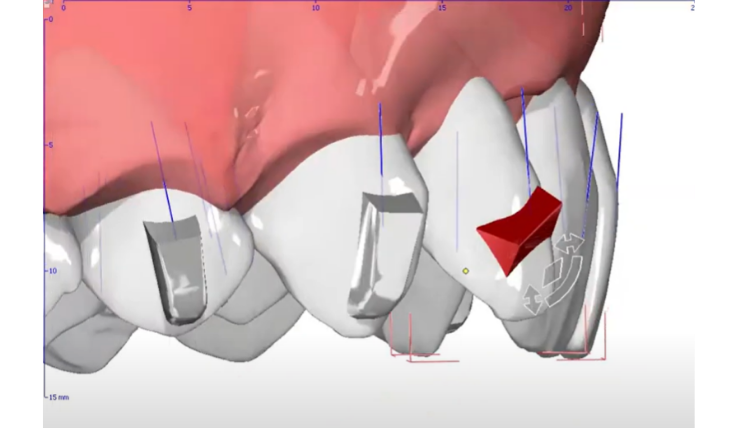
Class II Division 2 malocclusion is complex, with retroclined incisors, deep bite, and vertical challenges. The PIR protocol—Procline, Intrude, Retract—offers a clear sequence to manage these cases with stability and precision. Read how to optimize biomechanics, avoid pitfalls, and achieve predictable long-term outcomes.
Improving Molar Rotation with a Dual Attachment Strategy
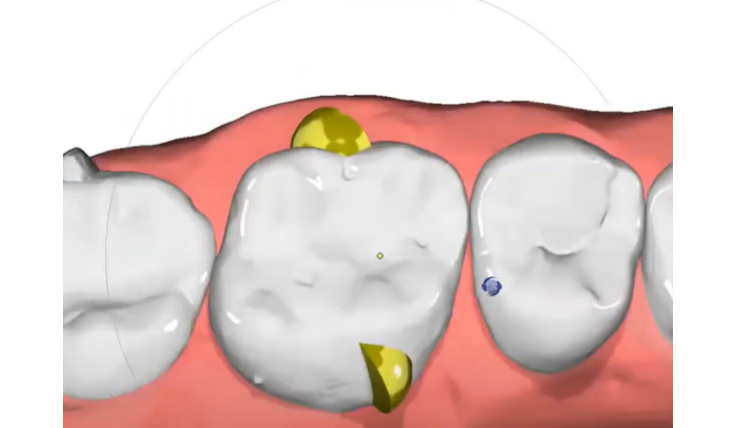
Molar rotation with aligners is tough—size and roots make movement unpredictable. Dual attachments, placed buccally and lingually, create a couple force for pure rotation and better control. With precise planning and placement, this method reduces auxiliaries and improves predictability in rotations over 10°.